/cbre_logo.png?sfvrsn=eac6e070_4 "cbre_logo")

How Can We Help You?
Sector and market analytics
Thought leaders abound
Advantage is CBRE
Which data are right for you?
Experience the platform
Click the link above to access all EA Insights
Low-correlation markets can help optimize portfolio returns
Harry Markowitz taught us the value of diversification for reducing risk within a portfolio of assets. One lesson is that, in a two-asset portfolio, it would be worthwhile to allocate some portion to an asset that offers lower expected returns and higher risk if the two assets are not perfectly correlated, as such diversification can improve the risk-adjusted return.
It’s important to understand how returns are correlated between markets. To do so, we analyzed the performance of 230 markets, which includes a mix of geographies and sectors, from Q4 1992 to Q4 2024, and calculated the correlation of returns for each pair of markets.
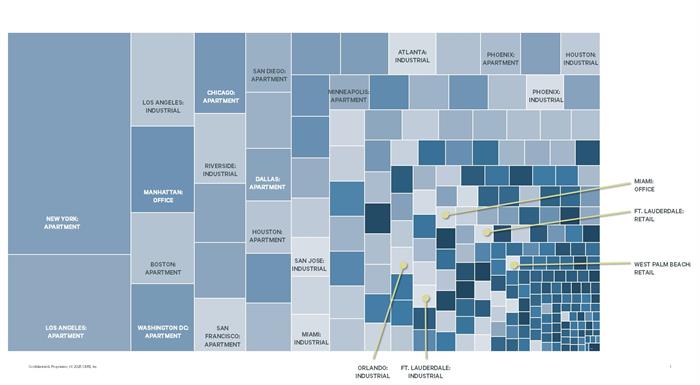
The tree map below shows the result of our analysis. The size of each box corresponds to the total capitalization of each market (total stock * value per unit/SF). Lighter boxes indicate a lower relative median correlation, while darker boxes suggest returns are highly correlated with other markets.
Generally, lower-correlation markets tend to be larger and generate more volatile returns over time. However, the performance of some smaller markets runs counter to this trend. For example, Florida markets like West Palm Beach Neighborhood, Community & Strip Center (NCS) retail and Fort Lauderdale industrial outperformed during the recent period of cap rate expansion. Conversely, many high-correlation markets delivered stable returns prior to 2022, before suffering from sharply negative appreciation since then.
This is not to suggest that low-correlation markets are always an attractive investment. Rather, it’s a reminder that, prior to making an acquisition, fund managers should consider how an asset is correlated with the rest of their portfolio. For example, an investor with a portfolio of New York City apartments could gain substantial diversification benefits by buying a San Francisco industrial property, as these markets have a historical correlation of only 26%.
Ready to Get Started?
60 second demos.WATCH NOW |
Experience the platform.TRY IT TODAY |


