/cbre_logo.png?sfvrsn=eac6e070_4 "cbre_logo")

How Can We Help You?
Sector and market analytics
Thought leaders abound
Advantage is CBRE
Which data are right for you?
Experience the platform
Click the link above to access all EA Insights
Eyeing Real Estate Returns Over a 10 Year Horizon
Our latest investment fundamentals forecast identifies markets that offer compelling opportunities over the next 10 years.
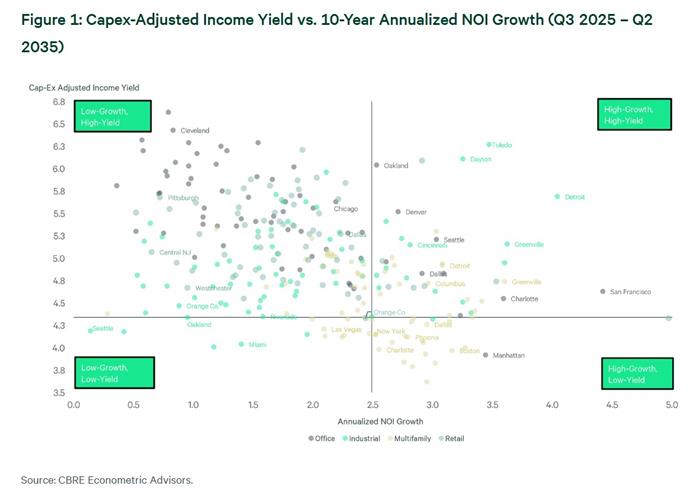
In all, we plotted 277 markets in quadrants that are defined by median capex-adjusted yield (vertical axis) and annualized 10-year NOI growth (horizontal axis). We forecast NOI growth based on expected changes in vacancy/availability rates and asking rent growth. When making our 10-year NOI forecasts, we place more emphasis on the first five years (70% weighting), when we have more confidence in our projections. The intersection of the quadrants represents the weighted average of all markets.
Many smaller markets are not on the radar screen of most institutional investors (e.g., Hartford retail) and therein tend to have higher yields as they attract capital mainly from regional sources. These markets also tend to produce more modest NOI growth. These markets are clustered in the chart’s upper-left quadrant. Not surprisingly, 80+% of office markets are currently in this quadrant.
Not all office markets hold dim prospects, however. San Francisco, Seattle and Dallas are prominently positioned in the upper-right quadrant because they presently offer both high yields and high growth. This also characterizes certain Midwest (Detroit, Columbus, Cincinnati, Dayton) multifamily and industrial markets, which are also in the upper-right quadrant. They have healthier fundamentals because they largely sidestepped the national construction boom of recent years.
Many major Sun Belt and supply-constrained coastal multifamily markets are clustered in the lower-right quadrant (high growth, low yield), suggesting that the upside in these markets may be largely priced in.
Manhattan is the only office market offering high growth and low yields. San Francisco or Seattle office would normally also be in this quadrant; instead, they are in the upper-right quadrant today, highlighting potential opportunities.
Few markets fall in the lower-left quadrant (low growth, low yield). Beleaguered port-driven logistics markets are the exception. Their outlook has deteriorated with a decline in global trade, yet asset pricing has been slow to adjust.
This analysis shows that different markets offer different opportunities via yield, growth or both.
Ready to Get Started?
60 second demos.WATCH NOW |
Experience the platform.TRY IT TODAY |


